From Ytterbium Cold Atoms
to Continuous Quantum Technologies
Motivation
The advent of optical atomic clocks with fractional frequency uncertainties below 10⁻¹⁸ has revolutionized frequency metrology — accumulating one second of error over the age of the universe — and simultaneously opened new avenues in quantum sensing and quantum information science.
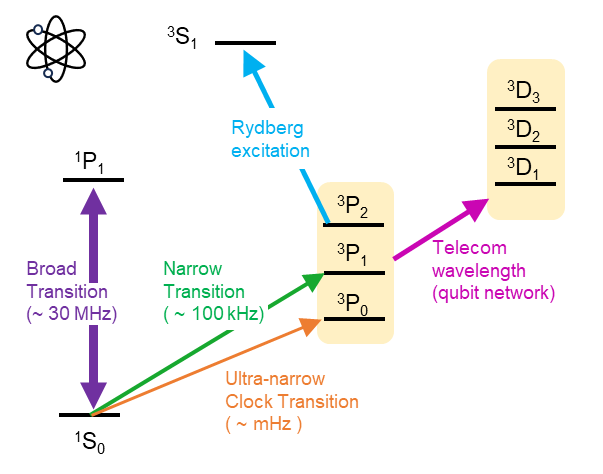
Among the leading platforms are alkaline-earth(-like) (AEL) atoms such as strontium and ytterbium. Their two-electron valence structure gives rise to a uniquely rich spectrum of optical transitions, from broad MHz-level lines to ultranarrow mHz clock transitions, allowing unprecedented control over atomic states — both internal and motional.
Crucially, the long-lived metastable states behind these clock transitions have not only enabled the most stable clocks to date, but also revealed a multidimensional qubit space — ground-state nuclear spin qubits, optical qubits, metastable hyperfine and nuclear spin states. AEL atoms are thus exceptional candidates for next-generation quantum technologies unifying precision metrology, quantum simulation, and scalable quantum computing.
Everything Starts From Yb
The 2022 Milestone
During their PhDs, the two PIs of our group published the world's first matter-wave analog of a continuous laser — a true continuous-wave atom laser — by developing techniques to maintain a high-flux, near-quantum-degenerate source of AEL atoms (Sr). This marked a major milestone in continuous ultracold atom generation and opened a new experimental paradigm [Nature (2022)]. A compelling question naturally arises: how does this continuous source architecture reshape the landscape of quantum technology?
Guiding Questions
Can we advance atomic clocks by replacing pulsed operation with continuous interrogation of optical qubits — potentially enabling τ⁻¹ scaling in stability, or realizing continuous superradiance on a mHz clock transition?
Can we link neutral-atom processing nodes, forming quantum networks?
Can the ultranarrow clock transitions be harnessed not just for spectroscopy, but as precision tools to engineer entangled and many-body quantum states?
Can we build a continuous, scalable quantum processor using long-lived metastable states — and how do we initialize, operate, and maintain such a system with high fidelity over time?
These guiding questions shape our ongoing work. Our goal is to develop the core control tools and system architectures needed to turn continuous AEL sources into the backbone of future quantum sensors, simulators, and computing platforms.