Research › Atom–Nanophotonics
Light–Matter Interfaces
The Vision
No single quantum processor will do everything. The future looks like the classical internet: many processors, linked by light. For neutral-atom machines that means an interface which can convert a stationary atomic qubit into a flying photonic one — efficiently, repeatably, and without destroying the fragile quantum state.
Our goal is to build that interface for ytterbium: engineered nanophotonic structures where single atoms couple so strongly to guided light that atom–photon entanglement becomes a routine resource — the elementary link of a quantum network, and the backbone of networked quantum computers.
Nanophotonic Interfaces
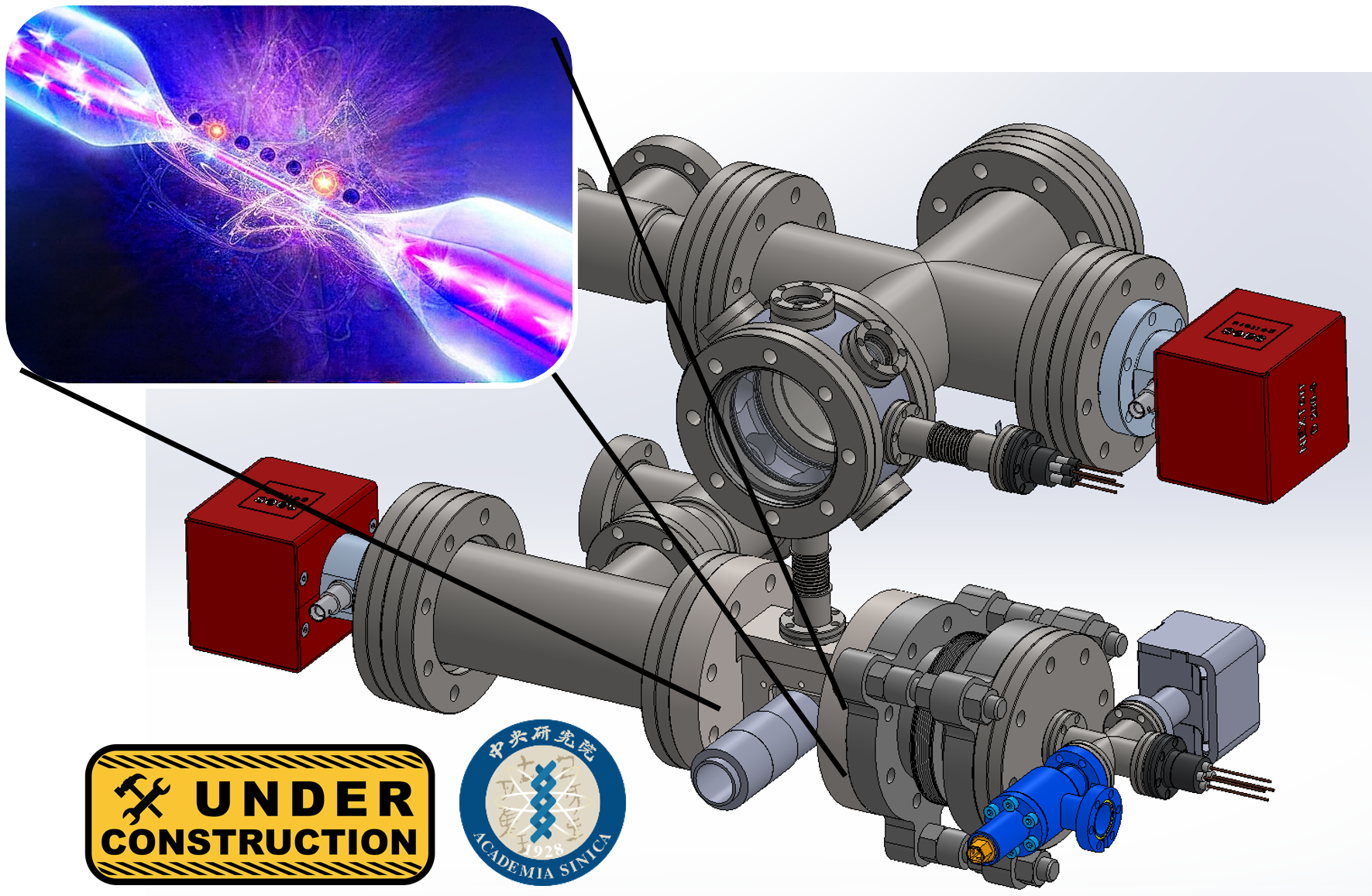
When an optical fibre is drawn down to a few hundred nanometres — thinner than the wavelength of the light it carries — a large fraction of the guided mode travels outside the glass, as an evanescent field. Atoms trapped a few hundred nanometres from the surface of such a nanofibre interact with every photon that passes, channelling their emission into the fibre with high probability.
Beyond nanofibres, photonic-crystal waveguides and cavities confine light to volumes below a cubic wavelength, boosting the single-atom cooperativity further still. These chip-scale structures are the hardware of strong light–matter coupling — no bulky mirror cavities required.
Ytterbium is an ideal partner: its telecom-adjacent transitions, long-lived metastable qubit states and clock-grade coherence let one atom serve simultaneously as memory, processor and optical emitter.
Toward Networks
Combine the interface with our continuous ultracold source and the payoff compounds: atoms lost from the interface are continuously replaced, entanglement generation can run repeat-until-success at high rates, and network links stay up indefinitely — the same always-on philosophy as our CW optical clock.
Long term, we aim at photonic links between neutral-atom processing nodes: distributed quantum computing, entanglement-enhanced sensor arrays, and clock networks connected at the quantum level.