Research › CW Optical Clock
CW Optical Clock
Why Continuous?
The best optical clocks today operate in pulsed cycles: cold atoms are prepared, the ultranarrow clock transition is interrogated for a fraction of a second, the result is read out — and everything is thrown away to start again. The dead time between interrogations does more than waste atoms: it lets the phase of the interrogation laser drift unobserved, aliasing laser noise into the measurement (the Dick effect) and capping the stability of even the most heroic machines.
A clock that never stops watching its atoms sidesteps this limit. With continuous interrogation of optical qubits, the local oscillator is phase-locked to the atoms at all times — potentially enabling τ⁻¹ scaling in stability rather than the τ⁻¹∕² averaging of cycled clocks.
Two Routes to a Running Clock
Passive route — continuous interrogation. A steady stream of ultracold ytterbium atoms flows through an interrogation region where a clock laser continuously probes the ¹S₀ → ³P₀ transition. Because fresh atoms constantly replace the old, the measurement never blinks.
Active route — a superradiant clock laser. Turn the atoms themselves into the oscillator: in the bad-cavity regime, atoms on a mHz-wide clock transition can collectively emit continuous superradiant light whose frequency is set by the atoms, not by a fragile reference cavity. A continuous source of cold atoms is exactly the missing ingredient such an active optical clock needs.
Both routes converge on the same requirement — the continuous, high-flux, ultracold ytterbium beam our lab is building.
What We Are Building
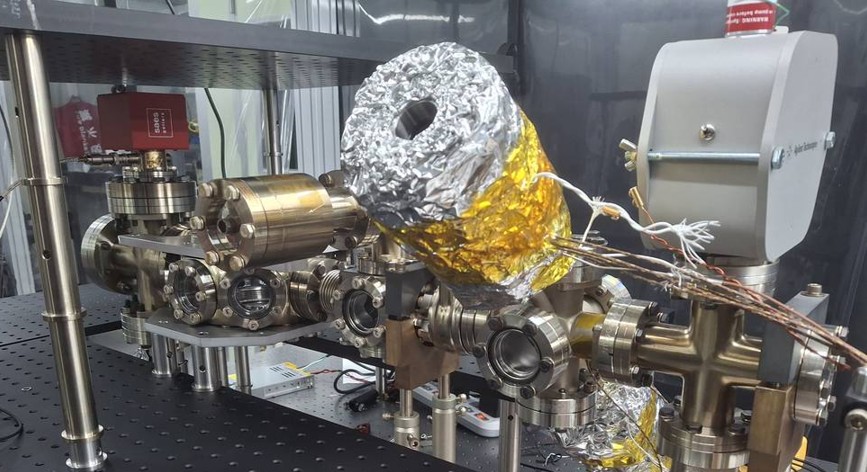
Our Pathfinder apparatus generates a continuous, laser-cooled beam of Yb as the front end of a running clock. Alongside it we are developing the spectroscopy tools to prepare, steer and read out atoms in the long-lived metastable states — see our work on high-resolution spectroscopy of metastable-state transitions — and the cavity and laser systems for continuous clock interrogation.
The long-term goal: an optical frequency reference that is always on — for metrology, for relativistic geodesy, and as a phase-coherent backbone for quantum networks.